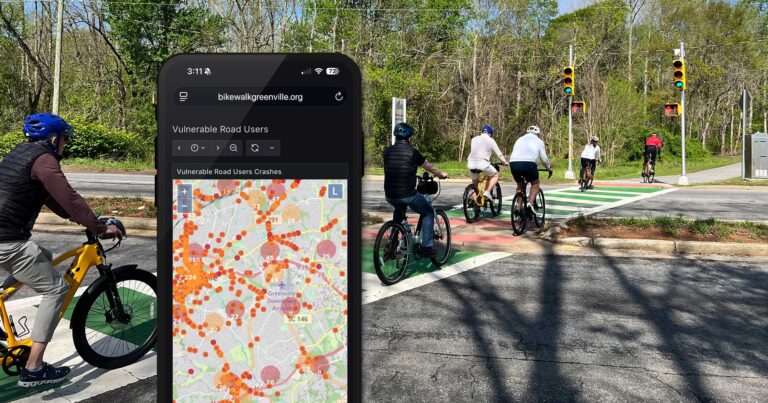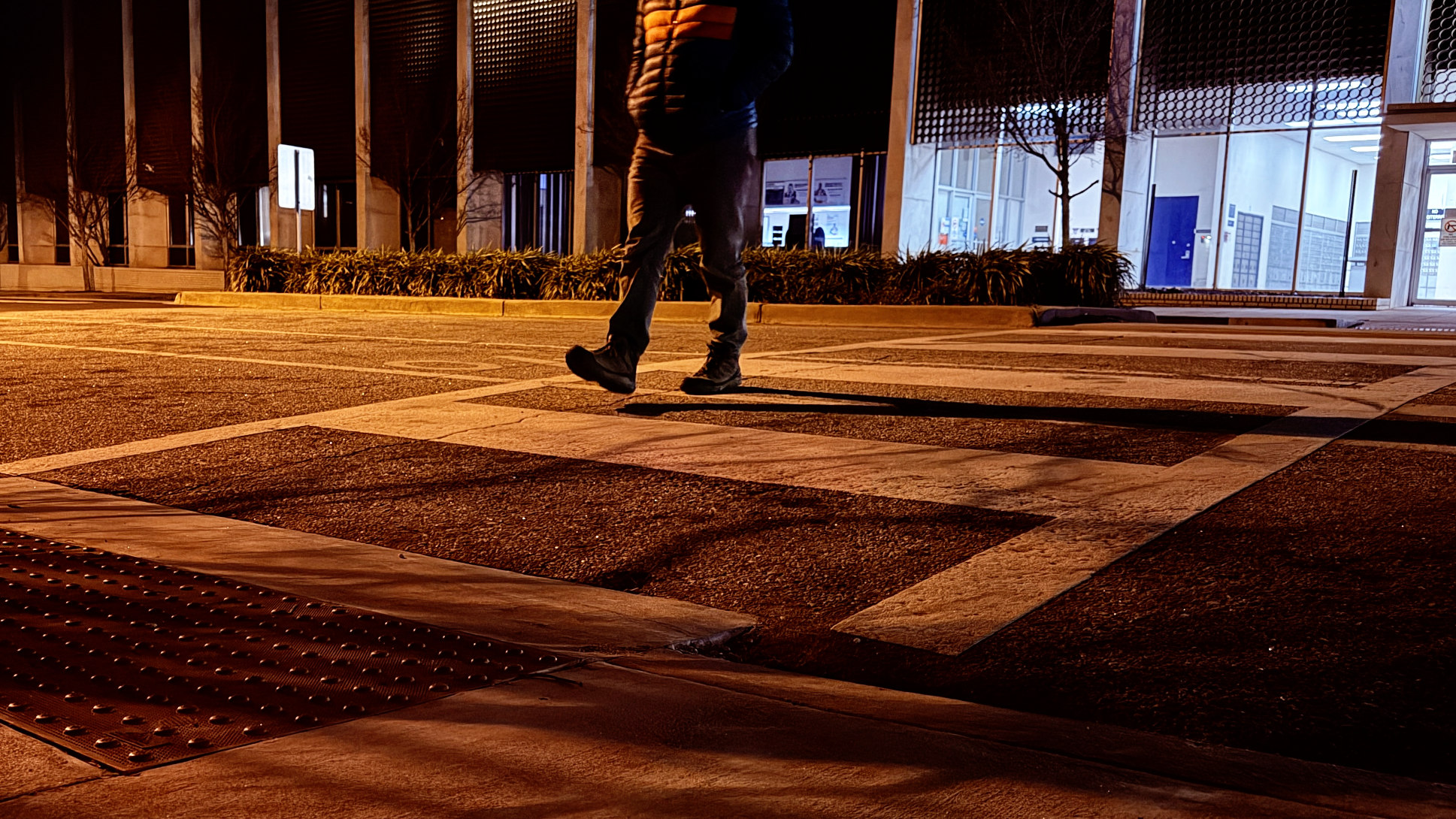
When the clocks change for daylight savings, the risk increases for vulnerable road users. Less daylight often means more vulnerability to pedestrians and cyclists, especially on poorly lit sidewalks and crosswalks. Just in 2021, over 7,300 pedestrians were hit and killed in the U.S., and 75% of the deaths were in the dark. In Greenville County, most vulnerable-road-user crashes occur after sunset. Bike Walk Greenville’s data team used the data from our previous Vulnerable Road User Map to show the relationship between streetlight prevalence and pedestrian deaths in Greenville County.
Using pedestrian crash data from SCDOT and streetlight location data from Duke Energy, we found numerous street segments in Greenville County where a lack of streetlights correlates with pedestrian deaths. These street segments are located throughout the county but are clustered primarily west of Downtown Greenville in the White Horse Road corridor. While a lack of lighting is not responsible for all pedestrian deaths in our region, and we can’t attribute any death to a single factor, we now have an idea of where deaths and low lighting occur in clusters.
The table below also shows higher crash counts during the darkest months (November, December, January) and also the darkest hours throughout the year. This table uses the same data from the 2014-2024 SCDOT reported vehicle collisions with vulnerable road users. Overall, more crashes, both fatal and nonfatal, occurred after sunset, with 633 reported in daylight and 684 in darkness. This difference is especially pronounced during the darkest months of the year. For example, there were 37 collisions in sunlight versus 88 in darkness for November collisions. Commuting pedestrians and cyclists face much higher risk on their way home from work especially in the winter.
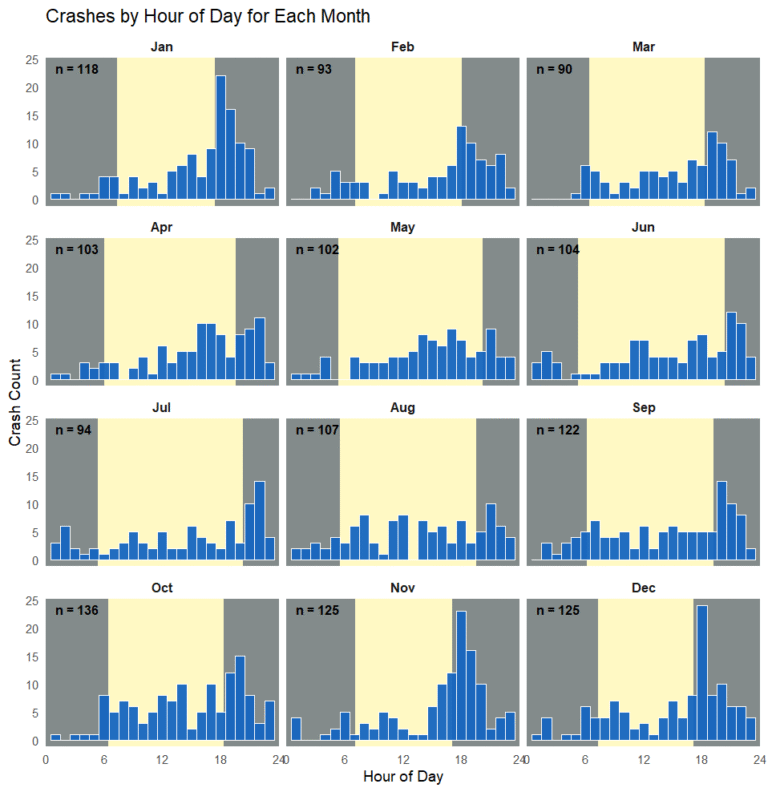
According to the 2025 AAA Foundation for Traffic Safety report, there has been a major surge in pedestrian deaths since a record low in 2009. This 80% increase has almost entirely occurred in darkness and on urban arterial roads. In all three cities that they focused on, the highest concentration of pedestrian deaths occurred in disadvantaged neighborhoods, which are most commonly located near poorly lit and busier roadways.
In the FHWA’s 2024 report on pedestrian and bicyclist fatalities, they found that minority race and ethnic groups were at increased risk of vehicle crashes due to the higher prevalence of poorly lit and unsafe roadways. They concluded that Black, Hispanic, and Native American communities experienced increased exposure to dangerous and fatal road conditions for walking and cycling. Overall, vulnerable road users face increased risk in lower-income areas due to inadequate lighting infrastructure along busy roads.
Bike Walk Greenville’s 2023 study of White Horse Road is an excellent case study to demonstrate these correlations. Because of the high collision rate, White Horse Road is a dangerous road with particularly unsafe intersections. From 2014-2024, there were 21 reported collisions with vulnerable road users just on White Horse Road The study area was located near the Walmart Supercenter, with 46% of its population nonwhite and a median household income below $30,000. A significant portion of residents biked and walked to work and commuted to other areas within the vicinity. According to SCDPS Greenville County Crash Data from 2017-2021, 55% of all crashes and 80% of fatal crashes occurred in the dark. White Horse Road is the worst possible combination of dangerous road design, poor lighting for vulnerable road users, and a lower socioeconomic community whose residents depend on walking or riding to and from their homes each day.
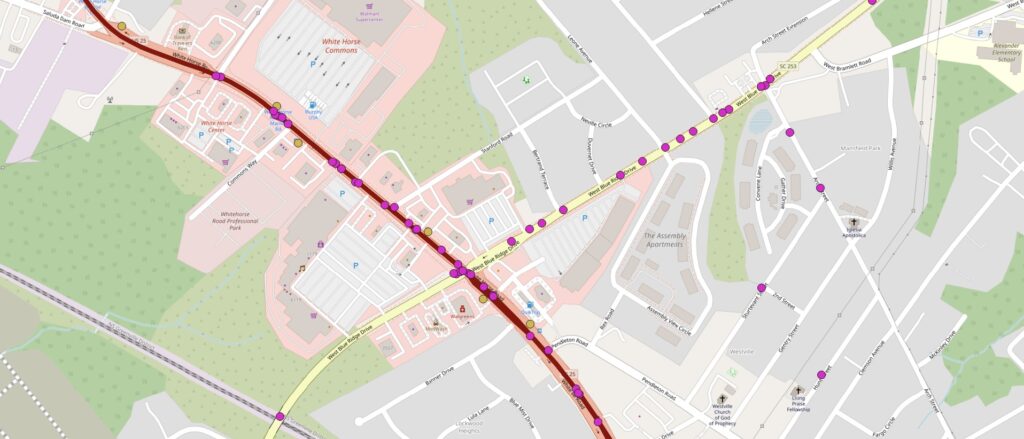
The picture below demonstrates this correlation with just one particularly dangerous intersection at White Horse Road and Blue Ridge Drive. The pink dots represent collisions whereas the few yellow dots represent lights. The locations and collision points are approximate, and based on public lighting record data and police report data. Overall, this is a clear depiction of far too many vehicle collisions with vulnerable road users along a road with far too few streetlights.
The simple solution is to increase visibility for vulnerable road users. With improved intersection lighting, higher-visibility crosswalks, and more streetlights along sidewalks, people can safely walk and bike at any time of day. A well-lit street can lead to a safer community for all its residents, no matter how we get around Greenville.